Ways to heal and thrive
This inner work section is not supplemental to the environmental crisis described on the site. It is central to it. Trauma and addiction are among the primary drivers of the metacrisis. People have done and created amazing things. There have also been an enormous amount of wars, slavery, and decimation of life. Today, living through the sixth mass extinction — watching ecosystems collapse, feeling the loss in the body — can be a source of trauma. From all of this, many of us can, without necessarily meaning to, further cause destruction to others and the living world. If we carry a lot of unprocessed emotions and trauma we’re more capable of extraction- exploitation — not because we’re bad, but because disconnection from self produces disconnection from everything else. The reverse is equally true. When we have connected attachment, genuine community, and tools for processing difficult experience we want to live in harmony with others and with the earth. It feels good. Healing the inner life and healing the outer world are not two projects. They are one. The frameworks and practices in this section are very important to help navigate this website, work with emotions, and stay grounded. Working with the material on this site is a living process.
Attachment: The Ground Beneath Everything
Attachment isn't a concept from therapy offices. It's the biological foundation of how humans stay regulated, connected, and capable of action. John Bowlby, who first mapped its architecture, understood that we are not built for isolation. We are built for proximity—for the experience of being held, known, and responded to. Before a child can regulate their own nervous system, a caregiver does it for them. Not through instruction, but through presence: a voice, a heartbeat, a hand. Harry Harlow showed this with devastating clarity in his experiments with infant primates—when forced to choose between a wire frame that provided food and a cloth form that provided only contact and warmth, the infants chose warmth. Contact comfort isn't supplemental to survival. It is survival. We are mammals who need to feel held before we can think, act, or grow.
What attachment provides, once established, is something developmental psychologists call a secure base. A child who knows they can return to safety will venture out—explore, play, take risks, encounter difficulty and recover. They will be curious rather than defended, flexible rather than rigid. Exploration and play aren't luxuries that come after security. They emerge directly from it. Creative engagement with the world, the ability to imagine alternatives, to collaborate, to experiment—these are the fruits of a nervous system that trusts it won't be abandoned. This is not a small thing. The bioregional regeneration work described on this site—cooperative governance, regenerative agriculture, community-led restoration—requires exactly this capacity. People frozen in threat response cannot build new systems. People who feel held can.
The metacrisis, seen through an attachment lens, reveals a pattern that is too direct to ignore. As ecosystems deteriorate, something in the nervous system destabilizes in ways that go beyond stress or grief. Many people who work with land and community across different ecological contexts observe the same thing: in places with healthy soil, functioning watersheds, and biodiversity, people process difficult things faster. Something in the body settles that won't settle in concrete environments stripped of life. This isn't metaphor. The living world has been a co-regulator for our species across hundreds of thousands of years—the sounds of insects, the presence of trees, the smell of healthy earth, the feedback of functioning soil under foot. Allan Schore's work on right-brain development shows that early attachment experiences literally wire the neural circuits responsible for emotional regulation. Those circuits don't stop needing input when we become adults. They remain relational, embodied, and environmental. When the ecosystem unravels, something in the regulatory system unravels with it. This is what we call ecodeath syndrome—not anxiety about abstract statistics, but a body-level sickness in environments barren of life. Earth restoration, even imperfect, even in a city, helps. It is not as good as intact ecosystem, but it is not nothing. It is being in relation to life.
Stephen Porges' polyvagal theory maps the autonomic nervous system as a hierarchy: when safety cues are present, the ventral vagal system activates, enabling social engagement, creativity, and repair. When those cues disappear—when the environment signals chronic threat—the system drops into sympathetic activation (fight, flight) or dorsal vagal shutdown (freeze, collapse). Industrial capitalism, at the level of nervous system, is a chronic safety-cue removal machine. It isolates people from each other, from land, from the slow rhythms of place. It replaces the security of belonging with the anxiety of competition—there is not enough, you must get more, your neighbors are rivals, the ecosystem is a resource to extract before others do. This is the precise opposite of the secure base. And the behavior that follows is predictable: people who feel chronically unsafe attempt to compensate through accumulation—more resources, more control, the illusion of more insulation from vulnerability. The overconsumption and extraction that drive ecological collapse are not simply greed. They are, in large part, the behavior of a species whose attachment systems have been systematically disrupted. Healing this is not only personal. It is structural.
Connection doesn't just feel better—it restores regulatory capacity that isolation destroys. Isolation magnifies despair; connection and witnessing restores regulation and agency. This is why healing from the metacrisis cannot be primarily an information problem or an individual discipline problem. People do not think their way back to regulation. They feel their way back, through relationship, through being met. For many of us, those relationships can extend to the living world directly—to a tree, a river, a watershed, a patch of soil being restored. Indigenous peoples across every continent, before and largely outside industrial culture, did not relate to forest, river, and ecosystem as backdrop or resource. They related to them as kin—as living others with presence, intelligence, and standing. This is not belief layered onto experience. It is direct perception, the baseline human relationship to the living world, which the industrial worldview systematically trains out of people. When we destroy a river or a forest we are not only losing “ecosystem services”. We are severing relationships that the nervous system registered as family. Of course people are dysregulated in ecocided landscapes. Of course the grief is beyond what most frameworks can hold. And of course that dysregulation, unmet and unwitnessed, loops back into more extraction—the severed person reaching for substitutes, for control, for accumulation, for junk food, for toxic media, in place of what was lost. The metacrisis is not an external problem that arrived from nowhere. It is the compounding result of that original severance, repeated across generations and geographies, until the hubris of separation from the living world became the operating assumption of an entire civilization.
Attachment theory usually focuses on caregivers, but the nervous system is not that narrow. What provides safety, mirroring, and the experience of being held can take many forms. The grief of ecosystem loss, when it surfaces, needs to be held in community and titrated carefully—too much activation at once overwhelms, too little slides into avoidance. But grief that is witnessed, especially in the presence of others who share it, does something important: it moves. Frozen grief keeps people stuck. Held grief releases energy for action. And action matters here, because action itself creates the felt sense of agency—small steps, visible and reported in relationship, rebuild what chronic helplessness dismantles. The path forward is not grand transformation. It is people, held by each other and by place, taking the next small step.
This is not a one-way flow. The bioregional community—the healthy watershed, the cooperative food system, the small group meeting regularly in a shared place—is not only the goal of the inner work. It is what makes the inner work possible. Secure attachment allows people to do regenerative work; the regenerative work deepens the attachment. Ecosystem health and relational health are not two separate things that happen to support each other. Healthy topsoil, clean watersheds, and consciousness are of the same web of life — and when that is remembered, the loop becomes less a strategy than a homecoming. This is the loop we are trying to enter: healthy place and healthy community producing the regulated nervous systems capable of tending both—the direct inverse of the extractive loop, where disconnection from land and people produces dysregulation, which drives accumulation, which drives further destruction.
Shame, Vulnerability, and the Recovery of Voice
Brené Brown spent two decades studying what keeps people from acting on what they know—and what allows them to begin again. Her work converges on a simple mechanism: shame is the belief that something is fundamentally wrong with me, and it survives through secrecy, silence, and isolation. It doesn't require dramatic humiliation to operate. For many of us facing the metacrisis, shame is the quiet voice that says: I can't fix this. I should be doing more. My choices are part of the problem. Others are managing better. What's wrong with me that I feel this much, or this little. Shame contracts. It narrows the field of possible action. It keeps us from speaking what we actually see, reaching out when we are struggling, or asking for what we need.
There is a nuance here that most conversations about ecological crisis avoid. Many of us in industrial nations are not bystanders to the harm being described on this site. The clothes being worn while reading this likely came from a mainstream store — from sweatshop labor. Our food, even when organic, likely caused diminishment—depleted soil, unjust wages somewhere in the chain, fuel burned for machines to grow it and to arrive here. The twelve-step tradition is useful precisely because it holds two things simultaneously that most frameworks collapse into one: surrender shame completely, and take full responsibility for our actions that are harmful. These are not in tension. They are both required. The person recovering from compulsive debting does not flagellate themselves over past spending—that produces paralysis, not repair—but they do make a rigorous accounting of where they are, commit to changed behavior, and work through very real and practical decisions in community: what to buy, where to source food, what work to pursue, how to live closer to the costs of living.
A young friend heard this framing once — that the metacrisis isn't out there, it's in the food we buy, the chemicals used to grow it, the fuel burned to move it, the people used as slaves to make our clothes. He thought for a while and said: if we looked at that honestly, we'd never even buy an apple. Exactly right, came the reply. We probably wouldn't. We also wouldn't have a metacrisis. That's not paralysis — that's clarity. And clarity, however uncomfortable, is where recovery begins.
This is not sentiment. It is the same skillful, supported, daily process of recovery applied to the extractive patterns most of us are embedded in. The alternative—moving between shame-driven shutdown and "it's the system's fault" dissociation—produces nothing. The middle path is honest, supported, and specific.
The lever Brown identified is precise: shame cannot survive being spoken and met with empathy. Not analyzed, not solved—met. The relational exposure itself, when received without judgment, dissolves the experience that was sustaining the shame. This is one of the mechanisms at the center of twelve-step work. People speak what has been unspeakable, in a room with others who understand it, and something shifts, in part because isolation ended. This is why the group structure described elsewhere on this site is not supplemental to the inner work. It is the inner work.
Brown distinguishes vulnerability from weakness: it is the willingness to be seen in uncertainty, to speak what is real without knowing how it will be received. For those of us who understand what is actually happening ecologically and economically, speaking that clearly can feel like exposure—to dismissal, to being labeled extreme, to the grief of others' inability to hear it. The impulse to soften, to perform optimism, to say it'll be okay when we don't believe it, is a fawn response (from fight, flight, freeze, fawn) disguised as social grace. Real vulnerability here means saying: this is what I see, this is what I feel about it, I don't know what comes next, and I need to say that out loud. That speaking, especially in small committed groups, is where connection becomes possible. And connection, as both attachment theory and Brown's work make clear, is not a comfort added on top of the real work. It is the condition that makes the real work possible.
This also means letting go of what sometimes gets called hopeium—the performed optimism that papers over the actual situation. In many spaces including those devoted to regeneration, there can often be a can-do brightness that, on closer inspection, is resting on the same foundation as what it claims to oppose: store-bought clothes, food grown with harm to soil and people, a car in the parking lot, comfort subsidized by the very extraction being critiqued. Some of that brightness is attached to economic interest — workshops, books, consulting, ecovillage projects. An ecovillage presentation that acknowledges it was built on a cleared organic orchard, then moves on with a shrug — what can you do — is worth pausing on. Not because it is worse than the suburb or the city, both of which sit on ecocided land that was never named at all. But because the naming was a door, and the shrug closed it. That closing — in a room full of people devoted to regeneration — is the pattern. That is not condemnation. It is the texture of the metacrisis disease: the place feels safe, the people are friendly, the intention is real, and the shrug happens anyway. None of that requires shame — but it does require honesty.
Dennis Meadows and Bill Rees are not optimistic, and they have looked at the data longer than almost anyone. The person recovering from debting isn't optimistic either — not in the surface sense. They do not say it'll be fine. They say: today I will take the next indicated action, in community, with honesty about where I am. That is a different thing entirely from despair, and a different thing entirely from false brightness. It is the quiet confidence of someone who has stopped lying to themselves and found, surprisingly, that the ground is more solid than the story was.
What that ground is made of has a name in the recovery tradition. Every AA meeting opens with the same words: experience, strength, and hope. That sequence matters. Hope comes last. It's earned — it arrives after experience and strength, not before them. It isn't a feeling about the future. It's the recognition, standing in a room with people who have looked honestly at the root causes of the disease, done their own inventories, made amends, and chosen a life of service to something larger than themselves — that this is possible. People are doing it. I have seen it with my own eyes. That is a completely different thing from hopeium. Hopeium is hope detached from honest reckoning. This is hope that has come through it.
Both things are true simultaneously. Meadows and Rees are right about the trajectory. There is, and will be, much suffering. And individuals can recover if they choose, and some will, and the work is real and not easy, and possible, and extremely satisfying. Recovery means being willing to sit with history honestly — including the history that shapes the present moment, the colonial dismemberment of entire societies and economies that built the inequality now driving the crisis — not in flagellation, not in rationalization, but in the same way someone works a twelve-step program: taking the next indicated action, in community, with clarity about what is actually happening and what needs to change.
The group dynamics that produce and protect false brightness — and the way spaces can close the door on their own most important conversations — are taken up directly in the group dynamics section.
Overall, the practical sequence looks like this: name the shame rather than hide it, which breaks the secrecy that feeds it; normalize the response — of course a nervous system overwhelmed by genuine ecological loss struggles — which breaks the isolating illusion that this is personal failure; speak it in relationship; allow the vulnerability to be received; and then take one small step that is doable and concrete. Not solve the crisis. Something visible, reportable, achievable. This sequence — used in twelve-step programs for decades before Brown named its components — is not a workaround for the real problem. It is the mechanism through which humans actually change behavior that has felt compelled and inevitable.
The Window of Tolerance: A Map for Emotional Regulation and This Work
The material on this site is not easy to sit with. Extinction rates, collapsing ocean systems, financial architecture designed to extract — these are not abstract facts. They land in the body. They bring up fear, grief, rage, despair, or sometimes a strange numbness. That response is not weakness. It is appropriate. The situation is already here, and our nervous systems know it.
But there's a threshold. Psychologist Dan Siegel called it the window of tolerance — the zone of activation where we can take in difficult information, feel real emotion, and still think clearly enough to respond with skill. Inside the window, some level of arousal is actually useful. It means we're not blocking things out. Grief, anger, and fear carry information. They tell us something real is at stake. The problem isn't feeling them. The problem is when the charge becomes too much and we cross the line — out of the window and into what researchers call hyperarousal or hypoarousal.
Hyperarousal is the flooded state: the racing heart, the spiral of catastrophic thinking, the sense that everything is urgent and nothing is manageable. It can feel like panic, rage, or a kind of frantic overwhelm where the nervous system is screaming and the capacity for clear thought narrows greatly. Hypoarousal is the opposite: the shutdown, the numbness, the fog. We keep scrolling but nothing registers. We know the facts but feel nothing. We go through the motions but we're not really there. Both states are common responses to material like this — even for those who've been sitting with it for years. And both can be made chronic by trauma, which literally narrows the window over time, making the threshold easier to cross in either direction.
The key thing — and this is genuinely important — is simply to notice. Moving outside the window of tolerance is not a personal failing. It's a signal. The nervous system is telling us it needs something. And there are real tools for coming back: slow diaphragmatic breathing, a short walk, going outside, feeling our feet on the ground, shaking out our arms and legs (the body stores activation and discharge is useful), talking with someone we trust, a body scan, a few minutes of qi gong or yoga. These aren't soft suggestions — they work by directly engaging the nervous system, not by thinking our way through it. The goal isn't to become numb to what we're reading. It's to stay present to it without being overtaken. That's the difference between useful engagement and the fight, flight, freeze, or fawn responses described elsewhere on this site.
As we move through this material, we can check in with ourselves. If we notice our chest tightening, our mind racing, or conversely a kind of glazed disconnection — that's useful information. It means we've hit a threshold. We can use one of the practices below and come back, take a break, return tomorrow, or reach out for support. The work doesn't require that we take it all at once. It requires that we stay honest about where we are. And the window itself can be expanded over time — through the very practices described here, through therapy, through bodywork, through genuine community. Trauma can narrow it. These practices widen it back. Self-compassion compassion is important. The same honest, non-judgmental attention we'd offer a good friend — noticing they're overwhelmed, gently redirecting, not criticizing — is what makes the window wider and the work sustainable.
One more layer worth naming: the body's capacity to stay regulated is not just psychological. It's biological, and it's affected by things we often don't connect to nervous system health. Sleep matters as much as almost anything — chronic sleep deprivation keeps the threat-detection system on a hair trigger (and sleeping and dreaming are improved through lower EMFs). Nutrition matters: real food, as unprocessed as possible, genuinely supports nervous system function in ways that are measurable and direct. Reducing or removing exposure to mainstream media, and especially to violent or fear-amplifying content, is not avoidance — it is discretion. The nervous system cannot distinguish between a threat on a screen and a threat in the room; constant exposure to graphic or frightening content keeps the body in a low-grade state of alarm. High electromagnetic exposure (EMFs) from devices and cell towers is an area of concern worth taking seriously. This is tending the instrument we use to engage with the world. It is very challenging if not impossible to do this work — or any of the work described on this site — from a body that is chronically depleted, flooded, or numb. The window of tolerance is the ground condition for everything else.
Curiosity
There's a particular quality of attention that makes inner work possible, and it isn't willpower or discipline. It's curiosity — the simple, almost childlike ability to wonder what is this? before deciding what to do about it. When something hard surfaces, whether it's grief about the world, anxiety that won't settle, or a knot of feeling with no clear name, the habitual move is to manage it: explain it away, push through it, or go numb. Curiosity interrupts that habit. It creates just enough space to look before reacting.
Pat Ogden, whose Sensorimotor Psychotherapy sits at the intersection of talk therapy and body awareness, teaches this as a foundational skill. The body is always doing something — feeling energized, holding tension somewhere, bracing, going still, pulling back — and those responses carry real information. Curiosity is what allows someone to actually notice that, rather than rushing past it. In sensorimotor work, mindfulness is described as being motivated by curiosity — meaning the point of paying attention isn't to control experience, but to genuinely meet it. That distinction matters more than it might seem.
For those of us sitting with the weight of what's happening in the world, curiosity is one of the most useful things available. Curiosity keeps us in contact with what's real rather than spinning into overwhelm or shutting down entirely. We don't have to resolve anything to be curious. We just have to stay interested in our own experience long enough for something true to come through.
Beneath the practices that follow is a simpler assumption- organicity: that life moves toward health when conditions allow it. Not through force, not through fixing, but through removing what blocks the natural unfolding. Microorganisms rebuild soil when the pressure is lifted. Ecosystems recover when extraction stops. Human beings are not different. But this only works if the blocking pattern is actually interrupted. In AA the condition is not picking up the drink. In Debtors Anonymous it's not debting. Here it's letting go of extraction and exploitation as a way of living. As Jung observed, if you can't take a hint from life, life will find harder ways to deliver it. Organicity isn't passive surrender. It's what becomes available once the obstruction is named and the direction changes. Then the work is less about striving than about clearing the way for what already wants to move.
A Menu of Emotional Regulation Tools: Comprehensive Eco-Grief and Trauma Practices
These practices are for working with ecological destruction, eco-grief, and ecodeath syndrome — the feeling of sickness and dis-ease when surrounded by concrete and areas barren of life. But they are also for something harder to name: the experience of living inside societies that have severed themselves from reality. When people around us may be acting as though the sixth mass extinction is an inconvenience. When the extraction and exploitation are so normalized, so late-stage, that pointing at an apple and naming what produced it sounds extreme. That is the disorientation of being relatively clear in an environment that has lost its bearings. These practices help us stay connected to our bodies, our emotions, and reality itself — even when the ecosystem is in bad shape, the economy is unraveling, and the people around us don't see the root causes and conditions. The practices are not supplemental. For some of us, they have been the difference between functioning and not. It is also a bridge that can make the challenging content on this site more digestible, and help people grieve, stabilize, and move forward.
We do not have to do these all at once. We can choose one practice, or move through them in sequence. We can do them for a few minutes, or however long feels right. It is highly recommended we go through the practices now, try them and get a feel for them, so we can use them as emotions come up and we explore the website further.
The practices also include specific methods developed by people who spent lifetimes mapping how trauma lives in the body and how it moves. Babette Rothschild, Bessel van der Kolk, Janina Fisher — each deepened what the previous generation knew. We know more now than we ever have about what actually shifts trauma and held emotions, what doesn't, and why. These practices carry that accumulated knowledge. They work.
1. Body Scan and Window of Tolerance Awareness
Bring attention to your body from head to toe.
Notice what is present without trying to change it: tightness, warmth, heaviness, numbness, buzzing, tension, or emptiness, etc.
You might name it simply:
“Something is tight in my shoulders.”
“Something feels heavy in my chest.”
“This feels numb.”
“This feels activated.”
Then notice where you are in your window of tolerance:
• Hyperarousal: racing heart, agitation, tension, panic, overwhelm
• Hypoarousal: numbness, fog, collapse, disconnection, heaviness
This is a way to notice if your nervous system needs anything. If outside the window of tolerance, or to ground or process more emotionally, continue with the other exercises.
2. Orienting & Micro -Anchor
Sit comfortably.
Name aloud 3–4 sensory details:
“I hear ___. I feel ___. I see ___. I smell ___.”
Then notice whether the setting feels safe enough for your body to settle.
If it’s actually safe, say out loud, “And I’m safe here, I’m safe here.”
If it’s not a safe environment, ecosystem, etc., add an agency statement:
“This place feels unsafe, and my body knows it. I am not trapped. I am taking steps to leave. I am moving toward safety. And/or I am taking steps for enviornmental and personal recovery.”
3. Pendulation
Bring to mind something painful, such as climate grief, species loss, collapse, or isolation. Notice where it lands in your body.
Then gently shift to something soothing or steadying: a tree, a memory of safety, a breath, a patch of sky, the feel of a chair beneath you.
Move back and forth:
distress → resource → distress → resource
You can add small movement if it helps: rocking, stretching, shoulder rolls, tapping hands or feet. This teaches your nervous system it can touch the pain without drowning in it.
4. Embodied Discharge
Stand or sit and shake out your arms, legs, spine. Let your body tremble if need be.
Do compressions on your body, squeeze arms, legs, feet, hands, etc.
Press your feet firmly into the ground, push as if to stand, then release.
This helps release stored trauma energy.
You can also add hums, sighs, growls, or shouting if that feels right.
5. Beginning Uses of Parts work and Voice Dialogue (Hal & Sidra Stone)
Core Principles
The Selves: We all have many selves—protector, pleaser, inner critic, visionary, wounded child, etc. None are “bad”; each developed to help us survive.
Disowned Selves: Parts of us we push away or deny. They often carry energy we need to reclaim.
The Aware Ego Process: The stance of awareness that can listen to each self without fusing with it. This is where choice and freedom emerge.
Facilitation: In practice, you “speak from” a self, often by physically shifting chairs or positions, then return to center and reflect.
How to Use It
If someone is carrying the unbearable weight of seeing ecological collapse clearly, while others deny it. Voice Dialogue can help you separate the voices inside you so you don’t have to carry it all as one overwhelming mass.
Step 1: Identify the Voices: (for example)
The Seer: The part of you that sees the collapse with terrifying clarity,—grounded, unsparing.
The Carrier: The part that feels responsible for holding the grief, rage, and blindness of the group.
The Clear Boundaried: The part that says, “I will not carry this for them. I will not carry blindness for the group.”
The Vulnerable One: The part that may feel unsafe, sick, alone, longing for community.
The Aware Ego: The position that can hear all of these voices, honor them, and choose how to act.
Step 2: Dialogue
Move (literally, if possible) into a different chair or space for each voice. And this is just an example, feel free to say as much as feels right.
Speak as that voice, not about it. For example, but say whatever is true in the moment for you:
The Seer: “This ecosystem is in collapse. I can feel it. These people are not doing anything, and many animals and people will suffer or die.”
The Carrier: “I’ve been holding this for everyone, and it’s crushing me.”
The Clear Boundaried: “I will not carry blindness for the group. That is not my role.”
The Vulnerable One: “I feel unsafe here. My body is sick. I need out.”
Then return to center (the Aware Ego) and reflect: “I hear you. I honor you. I don’t have to be only you.”
Step 3: Integration
From the Aware Ego, you can choose:
To let the Seer speak truth, but not be consumed by despair.
To release the Carrier from its impossible burden.
To empower the Clear Boundaried to set boundaries.
To care for the Vulnerable One with compassion.
Why This Matters
Voice Dialogue doesn’t deny the reality of collapse. It helps you not collapse inside it. By giving each part a voice, you stop fusing with just one (the Seer, the Carrier) and reclaim choice. You can say:
“Yes, the ecosystem is collapsing. Yes, people are not talking about it. And I am not carrying that blindness for them. I can feel it, name it, and still choose my next step.”
Say, for example, if in an unsafe ecosystem: “A part of me feels hopeless. Another part of me knows I’ve survived before. A part of me longs for healthy community and a healthy ecosystem. Another part of me is taking steps toward it.”
If helpful, call on resourced parts: “The part of me that (is empowered)… and knows how to endure. The part of me that worked with (doing something empowering)… and knows how to connect and thrive.”
This reduces shame and creates inner compassion.
Here’s a short script combining the tools:
“I hear the sounds around me. I feel my body in the chair. I see the light in the room. I feel my hands on the keys.
This place is unsafe, and my body knows it.
I am not trapped. I am taking steps to leave. I am moving toward safety.
A part of me feels overwhelmed. Another part of me knows I have survived before and can act again.
I can hold both truths: the grief of collapse, and the fact that I am here, now, with choices.”
5. Closing Containment
If overwhelming thoughts remain, jot them on paper. Fold it, put it in a drawer.
Say: “I’ve stored this. I can come back later if I choose. For now, I am here.”
End with one grounding breath, noticing your body supported by the chair or floor.
6. Attachment Practices: Carrying a Secure Base
What's happening to ecosystems is not only an ecological crisis. It registers as the loss of something that loved you back. The Amazon, the old-growth forest, the reef, the river: these were not backdrop. They were relationship. They held people the way a good community holds its members — with presence, intelligence, and a kind of recognition that goes beyond words. Losing them, or watching them be destroyed, is grief at a depth most frameworks can't reach. It can feel like madness. It can feel like dying.
These practices are not about managing that. They are about carrying what was real — and what remains real — into the present moment, so it can still do its work. The love for the Amazon, for example, doesn't stop existing because the forest was cut. It lives in the nervous system as imprint, as memory, as bond. These practices work with that directly.
A regulating presence can be a person, ancestor, animal, place, river, forest, or tree.
Internal Secure Base Close your eyes. Picture someone or somewhere that has felt genuinely alive to you — a person, an animal, a forest, a river, a reef, a part of the earth you loved.
The key move here, and it matters: bring them inside — not out there, not gone, but here, in your chest, your heart, your marrow, as close as feels right for you. When we imagine what we've lost as out there — distant, absent, gone — the nervous system registers longing and abandonment. When we bring them inside, the bond continues. The ecosystem is not fully destroyed. It exists as energy, as memory, as living imprint in your nervous system. When you recall the birds, the butterfly, the smell of wet earth — you're not imagining. You're activating what was real and still is.
Let your body register: I am not alone. I am accompanied.
Continuing Bonds You don't have to let someone or somewhere you've loved drift away into absence. Picture the person, place, or living world that matters most. Feel what you love about them — not what you lost, but what you love. Bring that as close as feels right. Let it be present rather than gone. This is not pretending. It is carrying what was real forward into now.
Dialogue with Place The ecosystem can speak if you let it. You can give the forest, the river, the jungle a voice as part of your parts work, from above — and listen. What does it say? What does it want you to know? Each voice carries its own wisdom.
Sensory Anchoring The body remembers. Use what it knows: recordings of ecosystems, the smell of earth, the texture of bark or stone. These aren't substitutes for the real thing. They reactivate a bond the nervous system still holds, and that reactivation is real — it works through the same pathways as presence.
Bone Marrow Rooting Imagine the intelligence of the forest, jungle, or living world sinking into your bones — not as a memory stored outside you, but as something you carry in your marrow. You are of this earth. That doesn't change when the land is damaged. The web of life lives in you as much as you lived in it.
A Closing Image for Sleep As you drift, let yourself be held by whatever place has felt most alive: The air thick with life. The chorus of insects, frogs, birds. The pulse of roots beneath you. The smell of wet earth. Not idealized — it wasn't always easy, and it was real, and it held you. A secure base that still lives in you. Carry it. It hasn't been entirely taken.
The attachment practices above work with what the nervous system holds in memory, body sensation and image. Now we’ll work more the voice. Before language, before ritual, before almost anything we'd call culture, humans were singing. Stephen Porges' research shows why that was never incidental — the voice is wired directly into the system that regulates safety, connection, and the capacity to stay present. What the attachment practices do through image and memory, vocalization does through sound and breath. They work with similar territory from different directions.
Vocalization, Singing, and the Nervous System
Stephen Porges' Polyvagal Theory maps how the nervous system moves between states — social engagement, fight/flight, and shutdown. At the center of that map is the social engagement system: a network linking the vagus nerve, the voice, the face, and the inner ear. Singing, humming, and toning sit directly inside that system. They are not just expression. They are regulation — some of the oldest and most direct access points the nervous system has to felt safety.
Humans have been singing together since before recorded history. Porges' work explains why it works, but the body already knew.
When you hum or sing, the exhale lengthens naturally, which settles the heart rate and reduces defensive activation. The vibration moves through the chest, throat, and skull in ways that appear to calm sympathetic charge — many people experience this as a softening from the inside. And the voice, face, and listening system activate together, signaling to the nervous system: there is enough safety here to express.
Singing with others deepens this further. The shared rhythm, melody, and timing are the same elements that built regulation in early attachment — a caregiver's voice, its pacing, its rise and fall. Co-regulation through sound is ancient and real.
The key is not performance. It might start with a barely audible hum. That's enough. Forcing intensity backfires — the nervous system reads incongruence quickly. Start where you are.
Simple practices:
Low hum: Inhale gently, exhale with a soft "mmm." Let it be low and easy. Feel the vibration in your lips, chest, face. Five to ten rounds.
Voo sound: Inhale, then exhale with a slow, low "vooooo" — like a distant foghorn, not forced. Three to six repetitions. Settles quickly.
Hand on chest toning: Place a hand on your sternum. Inhale, then exhale with any soft sound — hum, "ah," “om,” or "voo." Notice the vibration under your hand. One to three minutes.
Sing: Whatever you know, whatever comes. Make up words. Let it be imperfect. The nervous system doesn't care about pitch. It cares that you're using your voice.
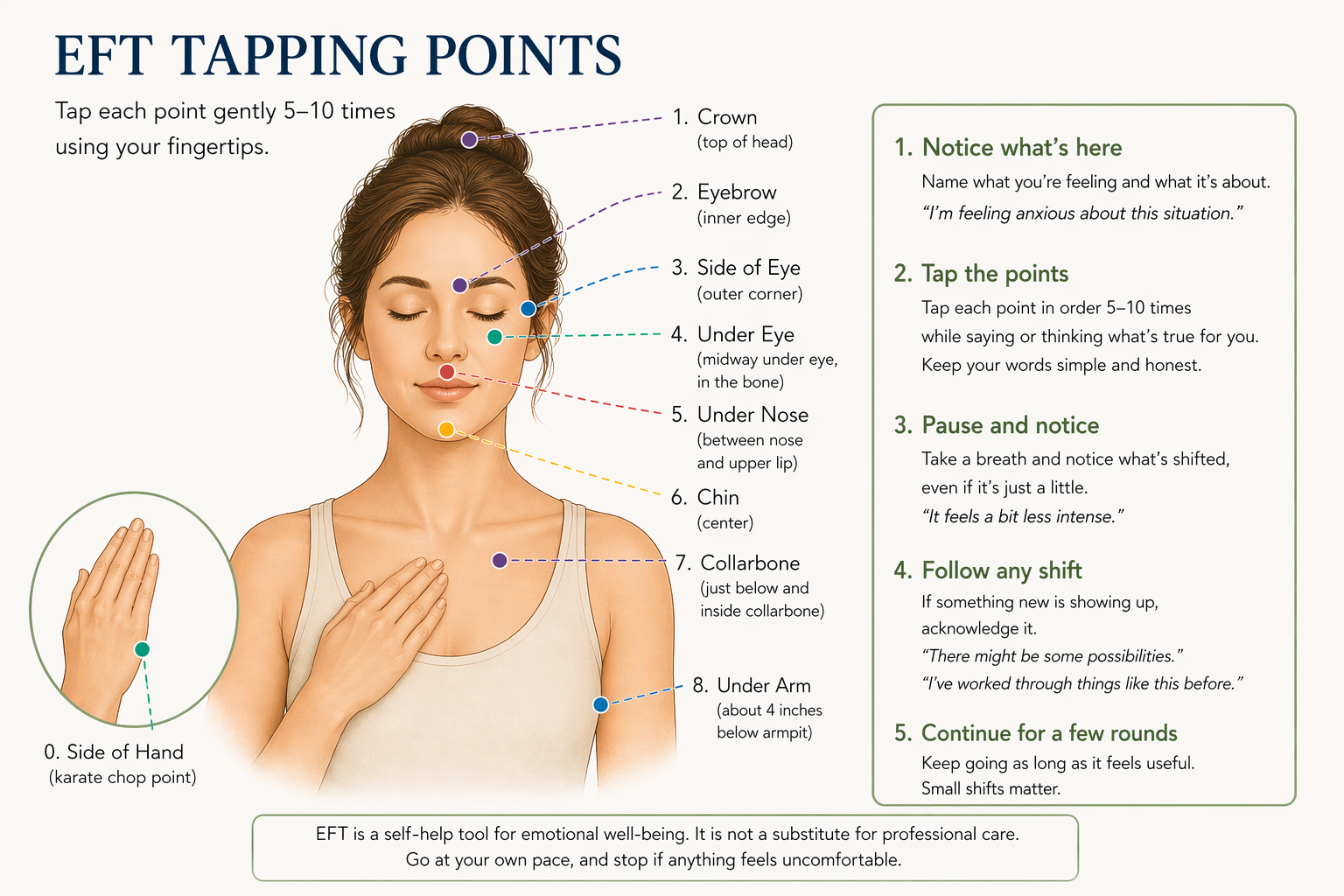
4. Emotional Freedom Technique (EFT / Tapping)
EFT involves gently tapping a sequence of acupressure points — a practice rooted in traditions that have mapped the body's energy pathways for thousands of years — while staying present with a distressing thought or feeling. Many people find that the combination of focused attention and tapping the points helps them move through difficult material with more ease, metabolize overwhelm, and sometimes arrive at unexpected clarity. It requires no equipment, no prior experience, and can be done in a few minutes anywhere. It also works well to modulate the nervous system if it’s running too hot — anxious, flooded, racing (hyperarousal) — or too quiet — numb, shutdown, unreachable (hypoarousal).
A Simple Tapping Practice (EFT) You can do this sitting or standing. No special preparation needed.
1. Notice what's here Take a moment and name what you're feeling, and do a body scan. "I'm feeling anxious… angry… sad… overwhelmed…" "It's about this situation…" No need to change it. Just name it.
2. Start with the setup Tap the side of your hand (the karate chop point) continuously while saying three times: "I'm feeling this [fear / tightness / overwhelm]." Start with what's true. That's enough.
3. Begin tapping the sequence Using your fingertips, gently tap each point about 5–10 times while speaking or thinking what's true for you.
• Eyebrow (inner edge)
• Side of the eye socket
• Under the eye
• Under the nose
• Chin
• Collarbone
• Under the arm
(Repeat the cycle if you like.)
4. Simple language while tapping Let the words stay close to your actual experience. "This fear…" "This tightness…" "This sadness about what happened…" "It's here in my body…" No need to be positive. Just honest.
5. Pause and notice After a round, stop for a moment. What's changed, even slightly? "It feels a little less intense…" "There's a bit more space…" "Still there, but different…"
6. If there's a shift, follow it You can gently reflect what's emerging now. "Maybe I'm a bit safer than I thought…" "I've moved through things like this before…" "There might be some possibilities here…" If nothing shifts, that's okay too — just keep naming what is true.
7. Continue for a few rounds The process is simple: notice → tap → say what’s coming up →notice again →. Even small shifts matter.